Porting Rockbox to an undocumented $9 Aliexpress 'YP3' MP3 Player with LLMs
Rockbox is a wonderful old custom firmware project for a variety of MP3 players and iPods. Flashing rockbox to my Sansa E200 was a seminal moment for me: computers were everywhere, and if they didn’t do cool things, it was because no one had bothered to program them to do so. Looking back, that played no small part in my choice of career.
It seems like in 2026 there aren’t any cheap MP3 players that Rockbox supports though. Reverse engineering an embedded platform like this is one of the hardest things I can think of, and I had decided to pay the big bucks for one of those delicious subsidized token plans to try and push it as hard as I could, and I did have a dirt cheap $9 Aliexpress MP3 player lying around.
TL;DR: it ported Rockbox to a 512 KiB player, I was barely involved. Then, I had it build a re-usable toolkit/set of skills for future ports based on what worked from the first attempt approach, and Claude was able to get Rockbox running on another MP3 player (TS47) in 4 hours.
I made a quick website for the project: https://rockslop.jayd.ml
Here is the porting toolkit: auto-rockbox
Enter: The YP3
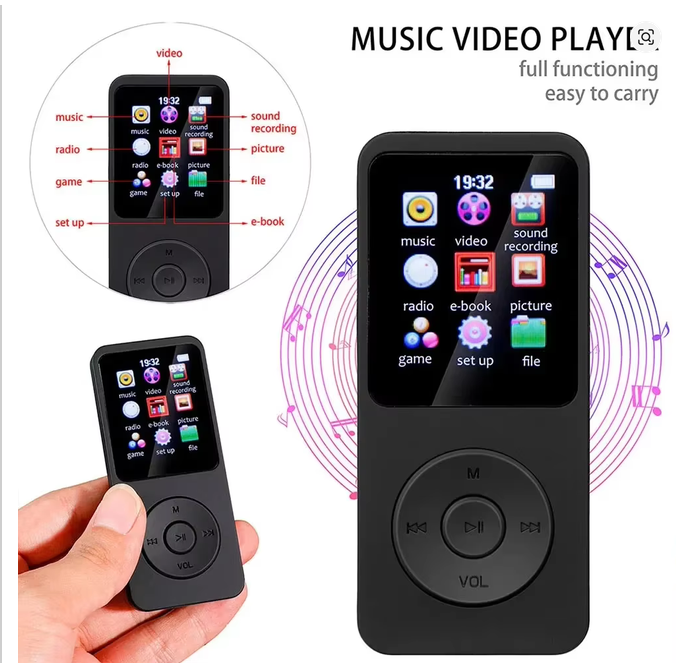
This is an unbranded player, sold under a variety of fake consonant soup brands on Amazon as well as Aliexpress. You can order them wholesale from Alibaba for less than $7 or so each.
It calls itself a yp3_2.0.43 in the “About” menu as. This appears to be a listing for a YP3 - the original is gone. I paid $9.71 for mine, shipped.
NOTE: Before you run off and buy one, I have another rockbox port that is probably a week or two out, it is booting and stable, just needs more acceptance testing. This device is extremely similar but has 4 MiB PSRAM, so it has fewer compromises
I also have a stack of other random MP3 players I intend to repeat this with
See the project website: https://rockslop.jayd.ml
Special thanks
If anyone gets credit for this rockbox port, it’s ilyakurdyukov - they figured out how to get it into ROM Download mode (Down + USB), and wrote a utility to dump / write flash. Then I could be a little slop kiddie and not have to use a soldering iron.
See the YP3 page on the project website for more info.
The good:
- It costs $9. If it breaks buy another one.
- USB-C and Blueooth!
- There is a physical reset button, device is easily recoverable
- Unbrickable (if you keep stock bootloader): holding down and resetting brings you into a DFU USB download mode.
- Someone already figured out how to flash and interact with ROM DFU
- That ROM DFU mode lets you poke flash and RAM.
The bad
- SoC: Complete mystery meat Chinese “Smartlink SL6801” / Jointbees. Does
not exist online
- 2x Cortext-M4 r0p1 cpuID
0x410fc241 - 192 MHz (stock does not vary CPU freq). Has an FPU
- Capable of Execute In Place (XIP) from flash, but no cache at all. Slow as dirt.
- When XIP-ing code, cpu1 always waits behind cpu0 and can stall indefinitely if cpu0 is continuously fetching instructions from flash. Very easy to deadlock
- 2x Cortext-M4 r0p1 cpuID
- SRAM 512 KiB plus about ~30 KiB for packets for the bluetooth radio.
- 2 MB Flash ROM
- 128x160 full color LCD (RGB565)
- Only 5 buttons - a dpad with a center press (center press is power & wired to PMU)
- Bluetooth (with an undocumented stack)
It has 512KiB of SRAM, and the smallest existing Rockbox target was 2 MiB, I was already scrolling Aliexpress for another one, but the LLM said “trust me bro I can make it happen” and I decided to try its luck.
The ugly
- While the hardware is cheap but functional, stock OS is painful to use
- It regularly crashes and watchdogs when in USB transfer mode
Where the port ended up
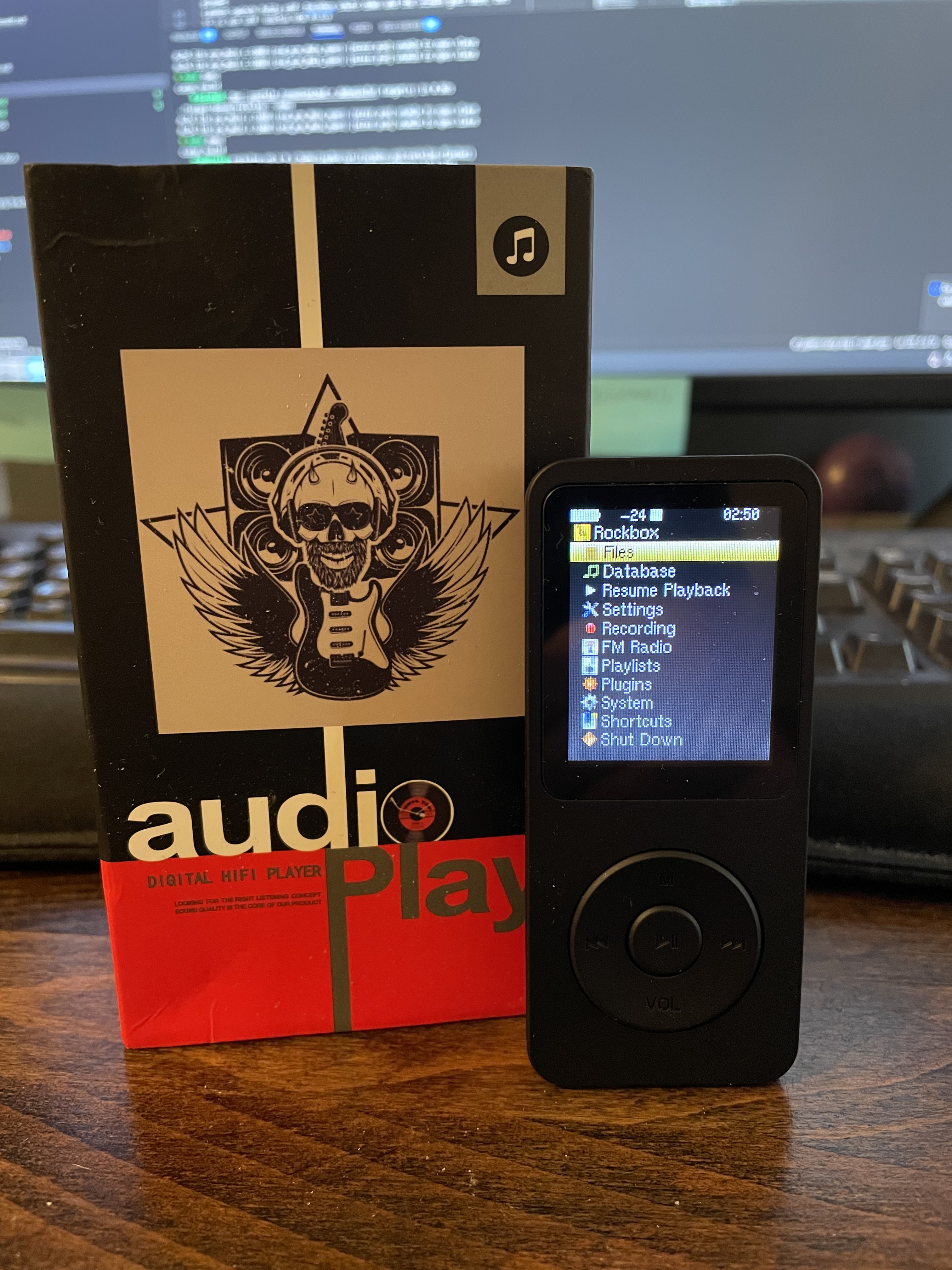
YP3 running Rockbox
After about a week it was booting a build of Rockbox on a crash diet - every single buffer had been cut to the bone, but it could start and play audio. Tuning, bug fixing, etc took another month or so.
I am not aware of anything that isn’t working hardware wise.
The main feature you lose is concurrency while playing music and plugins. Codecs and plugins are already loaded and swapped around at runtime with normal Rockbox, but on this player there is one shared 128 KiB arena for both, so starting a plugin stops music playback.
Other cuts include:
- No voice
- Only English is supported
- DSP: No pitch/speed control, surround, crossfade
- Cuesheets
- album art
- Theme backdrop pictures
- No dircache, so folders are read straight from SD card
- Large folders are truncated by default at 256 (configurable from 32 to 512)
- Playlists are capped at 400
- Codecs: WMA Pro, Musepack (MPC), RealAudio (Cook), and the chiptune formats SID, NSF, VGM, KSS, HES, SGC, ASAP. WavPack (16-bit), (24-bit/96 kHz)
What made it, somehow:
- MP3 (up to 320 kbps), AAC/M4A (AAC+ too, HE-AAC v2 plays in mono), WMA, Opus (up to ~192 kbps), Ogg Vorbis, FLAC (stereo, up to 24-bit/96 kHz), ALAC, WAV, AIFF, AU, TTA, APE, Speex, MOD, SPC, AY, GBS, A52/AC3, ATRAC3, Shorten, ADX, VOX, SMAF.
-
The database.
The database has a new variant that is disk only and has synchronous, blocking updates (ie the player shows a loading screen and stops music when it refreshes and doesn’t refresh in background). I think it also cut the “songs by letter” menu.
The database requests memory for its menus at runtime, and depending on the size of your theme it can refuse to open the menus.
- Themes, without backgrounds. load and work, although heavy themes can cause the database to stop opening (handled gracefully with a warning)
-
Bluetooth
Overnight Claude reverse engineered the bluetooth stack and wrote a bluetooth HAL for Rockbox. I asked it before I went to bed and it was working in the morning.
No binary blobs are shipped: the bt stack is burned into chip ROM (not flash), and the YP3 bluetooth driver calls into the stack.
A note on codecs
Most of the codecs run from SRAM as normal. MP3, AAC, WMA, Vorbis and Opus, however, wouldn’t fit in our arena nicely, so they run from flash.
But, our XIP flash is dirt slow, so lots of very careful profiling was done to move hot code loops back into SRAM. This kind of profiling had to be done all over Rockbox to get hot loops into SRAM - font rendering, alpha blending, scrolling, etc. This is where most of the “weeks of polishing” went.
Battery Life
Largely comparable to stock. I hooked the player up to the PC’s line in or fake bluetooth sink and set it to repeat Daft Punks Random Access Memories. A script on the PC detected when it cut out.
Stock: 21.29 hours wired, 20.07 on Bluetooth
Rockbox: 20.07 hours wired, 19.3 on Bluetooth
There was some variation in the battery voltage at start, and this was just one run, so expect some variation.
Battery life is surprisingly impressive on this player,
Approach
I’m one of those software guys, I can’t solder or find UART pads to save my life. This was an entirely software only port; I haven’t ever opened mine up.
I hooked up ghidra-mcp and let it start pulling the firmware apart. It figured out how to inject tasks into the running RTOS (FreeRTOS) in bootloader mode. This allowed it to probe the hardware and even write drivers before attempting a Rockbox boot.
To be clear: this is 100% vibecoded. I have only glanced at some of the code it wrote. I contributed my approach to development and testing, was the PM and QA person, and the agent’s little meat robot to reboot it when it crashed or wander around my house with headphones on while it tuned the bluetooth radio. I haven’t doneC and firmware development for years.
Cleanroom
Initially I let the same agent do the reverse engineering as implementation. Later I had it go through and rip out anything that wasn’t a hardware fact (ie a register) and re-did the drivers with a cleanroom setup. One dirty agent with Ghidra, one referee agent in between to make sure nothing leaks, and the implementation agent. Subsequent ports used a variation of this setup from the beginning
The most work I have done personally on this project is writing this blog post.
Robotic eyes and ears
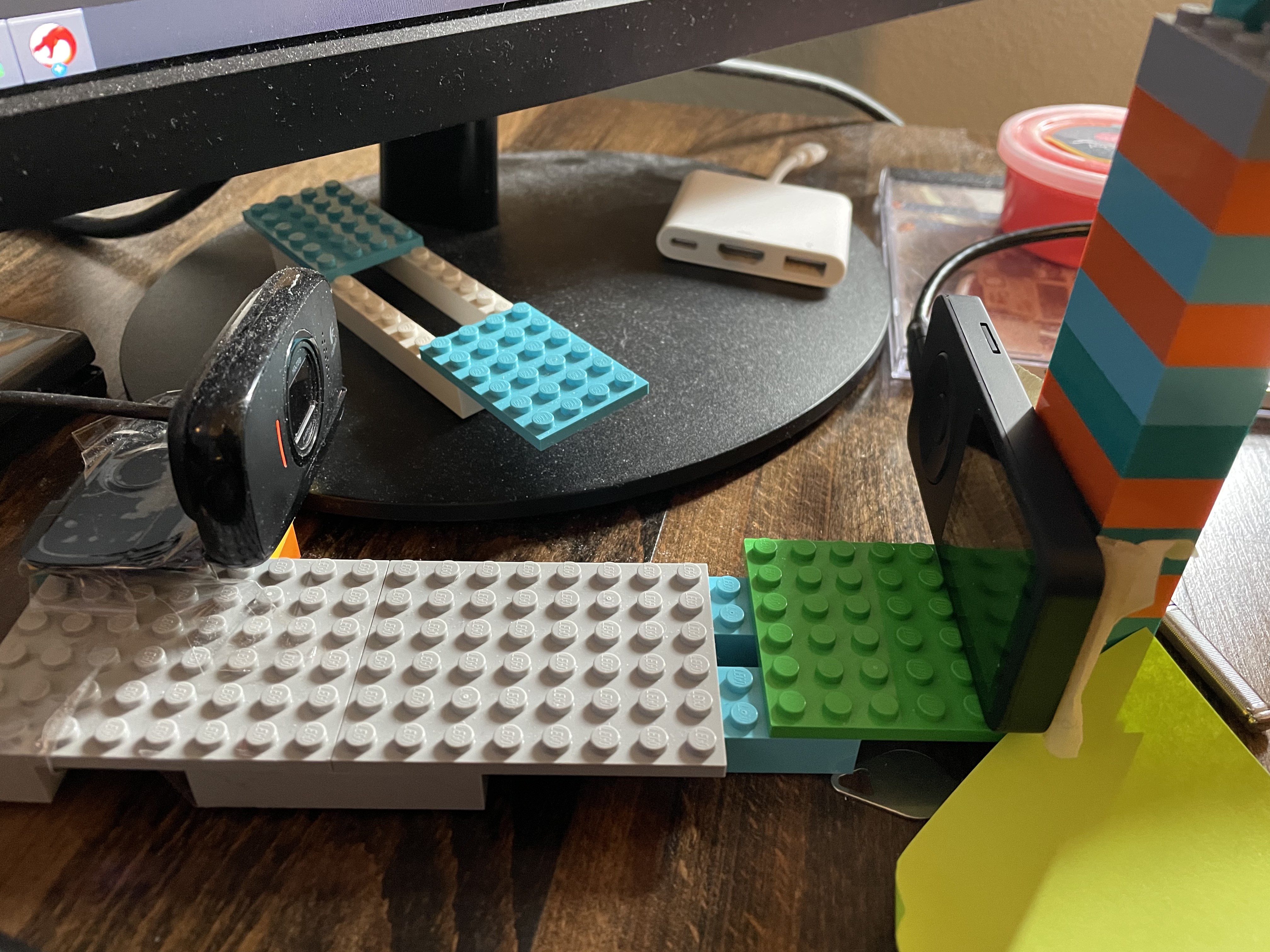
- Webcam pointed at the screen, so the model could see what the player was doing and to work on the LCD drivers.
-
Webcam mic for bringing up the speaker
(had to yell at Claude when it decided to start playing tones at 2 AM)
-
Headphone jack plugged into Line In on my PC (finally, I used it!!)
This allowed it to test and tune audio output.
- Bluetooth adapter. I plugged in a bluetooth adapter and gave it full reign for testing. It used Google’s Bumble python bluetooth stack to have the PC pretend to be headphones
- Claude kept picking “We Will Rock You” as a test track. I choose to believe this is evidence of a subtle sense of humor when working on a Rockbox port
Opus 5.5 »»»> Sol
This port was started with Codex/Sol 5.6. It was making progress, but was incredibly risk averse and slow. It took it 5 days or so and dozens of manual resets on my part until it felt ready to flash something and boot it.
I should have told it how to figure out how to arm the watchdog and reboot into download mode itself sooner. Codex got it to showing the rockbox logo with buggy drivers stubbed out, but had clearly lost its mind in the meantime. I hadn’t been paying attention too closely, but as it had spun around it had:
- Created 55 GB of files in 2,567 dirs. 3.87 million files total
- 443 one off tool scripts, 384 documents written
- an incredibly paranoid flasher that would check each block as it was written
and took 15 minutes to write 2 MiB
-
This flashing script - and many other tool scripts - would check the sha256 of the documentation files they depended on to ensure nothing had changed.
It’s kind of beautiful in its own insane way: this seems to be an attempt to work around multiple agents and memory limits. Madness though
-
- An MCP server with tons of ceremony and tools around flashing things, running tests, etc
Claude immediately threw that garbage away and wrote like a few python scripts to use instead. Auto mode in claude code helped too.
The subsequent TS17 port went from me plugging it in to a usable alpha build in about 4 hours with Opus 5.5 (there was little to re-use from the YP3 other than scripts and skills).
Bidirectional Rockbox Dev Shell
This is one of the most valuable things it did. Rockbox has an existing one-way USB serial driver for logs. I had that extended to have dozens of little commands to drive the player, everything from injecting keypresses to taking screenshots to debugging the bluetooth radio.
This was critical for completely hands off development - I had it build a torture test suite in Python that would monkey-test the player for hours, pressing buttons at random. Many bugs were found doing this - including some in Rockbox upstream. At this point the player has hundreds of hours of bench testing under Rockbox - I could just leave it running and Claude would patiently watch the test logs for new failures to diagnose and fix.
An agent can reboot to recovery, flash firmware, reboot into Rockbox, run tests, see what is on the screen, hear what it is doing, completely on its own. Most of the development of this project happened while I was asleep.
Audio Tuning
For audio (and battery endurance testing) Claude had me set up a 3.5 mm splitter with one end going into the PC’s Line In and the other going into real headphones to provide an actual load.
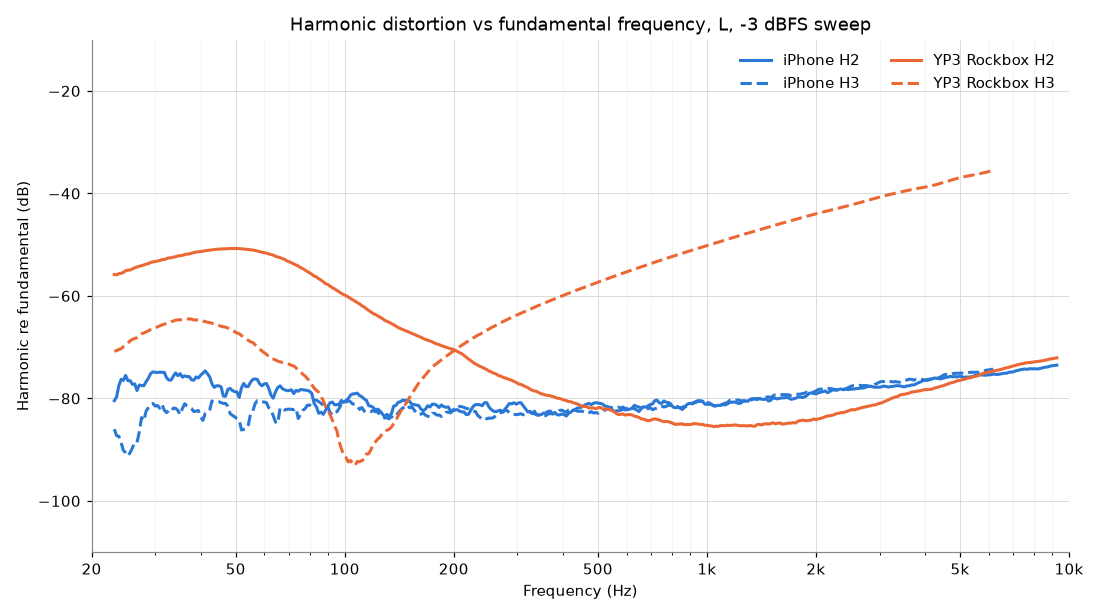
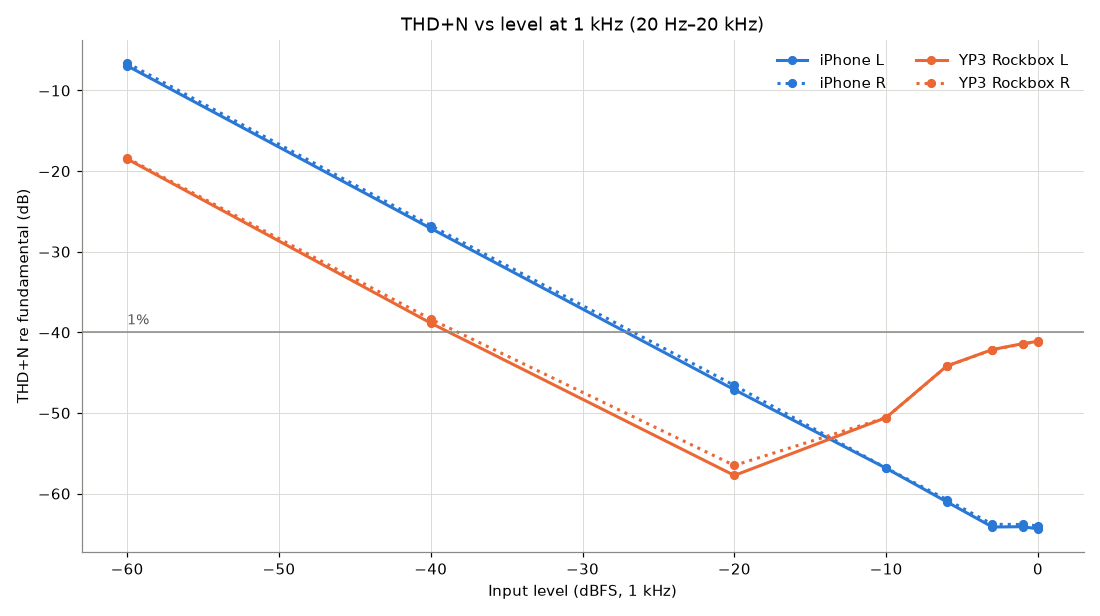
Then I had it build a test suite and file that plays a variety of sweeps and test tones. I used an Apple lightning adapter to use as the ground truth for this setup, then used it to compare audio levels and frequency response.
My PC’s sound card is not high sensitivity equipment, but this is enough of a sanity check for me.
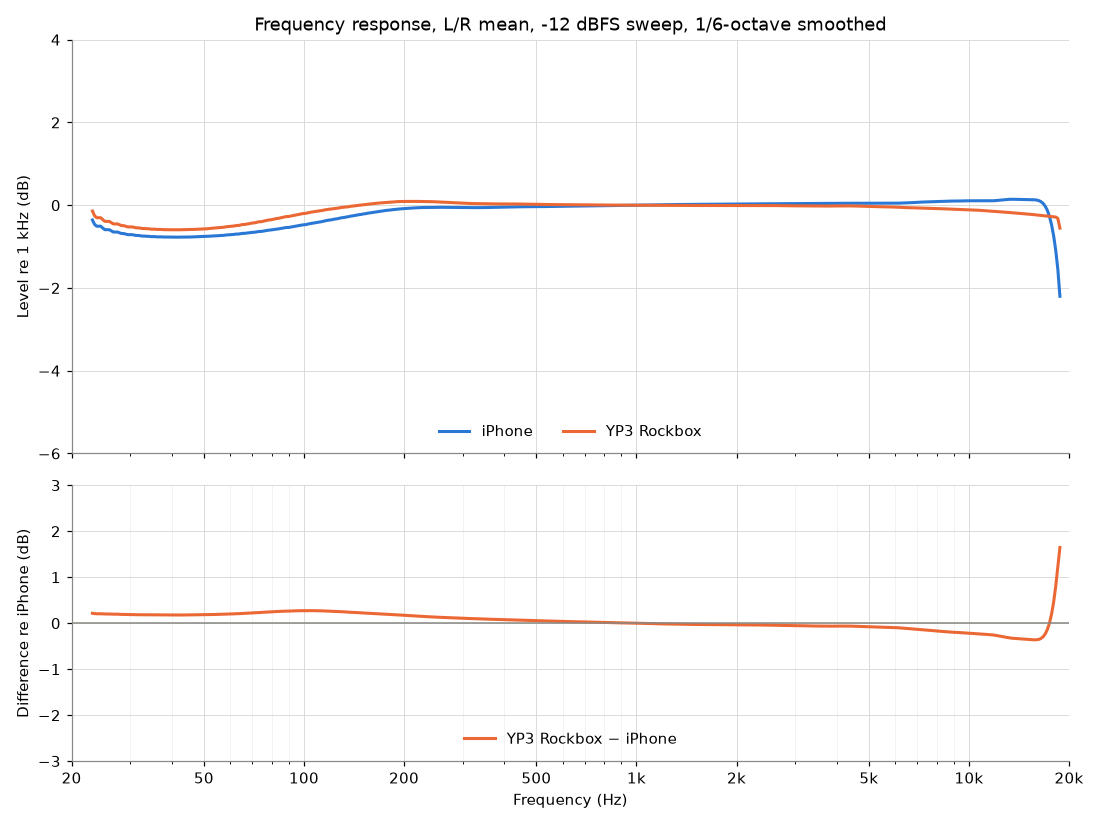
More charts that I don’t understand</summary>
 </details>
The Hardest Parts
There were two tricky things to work out that Claude struggled to fix.
The exact power off sequence took quite a few tries, probably because it was the
only thing I had to be there to test, it couldn’t just work on it for hours
overnight.
The other crazy bug was that the FM radio sounded terrible. You
could tune to a station, but the sound was distorted and clipped. Claude spent
forever trying to figure out why, but eventually I noticed that the frequency
it was tuned to did not match the station identifier over the air.
It turns out the tuner had been set up with a slightly wrong clock source, so it
was ~4 MhZ off. It just so happened to work out that when I tuned it to my test
station, it could kind of lock on to another one, but sounded terrible.
Other New Features
Plugin Psychosis
I told Claude to port as many games as it could to Rockbox.
This release adds THREE HUNDRED AND FIFTY SEVEN new plugins. That is not a
typo: 357. Most of these are ports, a few are originals. Given the quantity here
I haven’t done enough QA here.
Originals
RockGPT
This is going to get its own blog post because it is deeply amusing. A ~1 million
param model running on your MP3 player. Almost coherent, fine tuned to be aloof
and dismissive of humanity. Weights are streamed from SD card. Crazy
RockTrack
A little tracker/chiptune editor for Rockbox. I haven’t had a ton of time to
test this one. Probably needs ergonomic improvements.
Video Player
Rockbox’s existing mpegplayer didn’t fit on the YP3 and I didn’t want to hack
it up too much, so I had Claude write a new one, with a nicer pixel art UI,
MKV support. AVI, MKV, MP4; MPEG-1/2, MJPEG.
Ports
There are too many to list. Here is the full set of ports
- Anarch - FOSS DOOM clone
- Celeste Classic - Platformer Maddy Thorson, Noel Berry
- MicroCity City builder, jhhoward
- Prizm Racing, Racing, duarteapcoelho
- Rockcraft Minecraft-style block sandbox, port of Blocks-TI-84 by The Science Elf, MIT
- Terrario, Terraria-like KBD2
- Jet Island, 3D island demo CubeCoders
- Rock88, 3D rendered Film player demo JetExamples
Bulk Ports
We got to stupid plugin numbers by writing compat shims/libraries for several
popular open source players:
- Arduboy: 240
- Pokitto: 23
- Flipper Zero: 33
- Gamebuino: 17
Misc Features
- Enhanced RDS: program type names, call letters, clock time, RadioText+
(artist/title)
- Charge limiter (hardware dependent, allows 50-100% cap)
-
Bluetooth HID drivers
Yes, you can pair a PS4 controller or keyboard to Rockbox. I wanted to see how
much we could do with the existing Bluetooth stack
- Bluetooth headset battery level detection, with an icon in the status bar
Themes
I had it port some themes from the Rockbox website to work on this screensize,
add a bluetooth status icon, and it generated 5 original themes: Ukiyo (my
favorite), Asterism, Chaldani, Lavenia, Cyanotype.
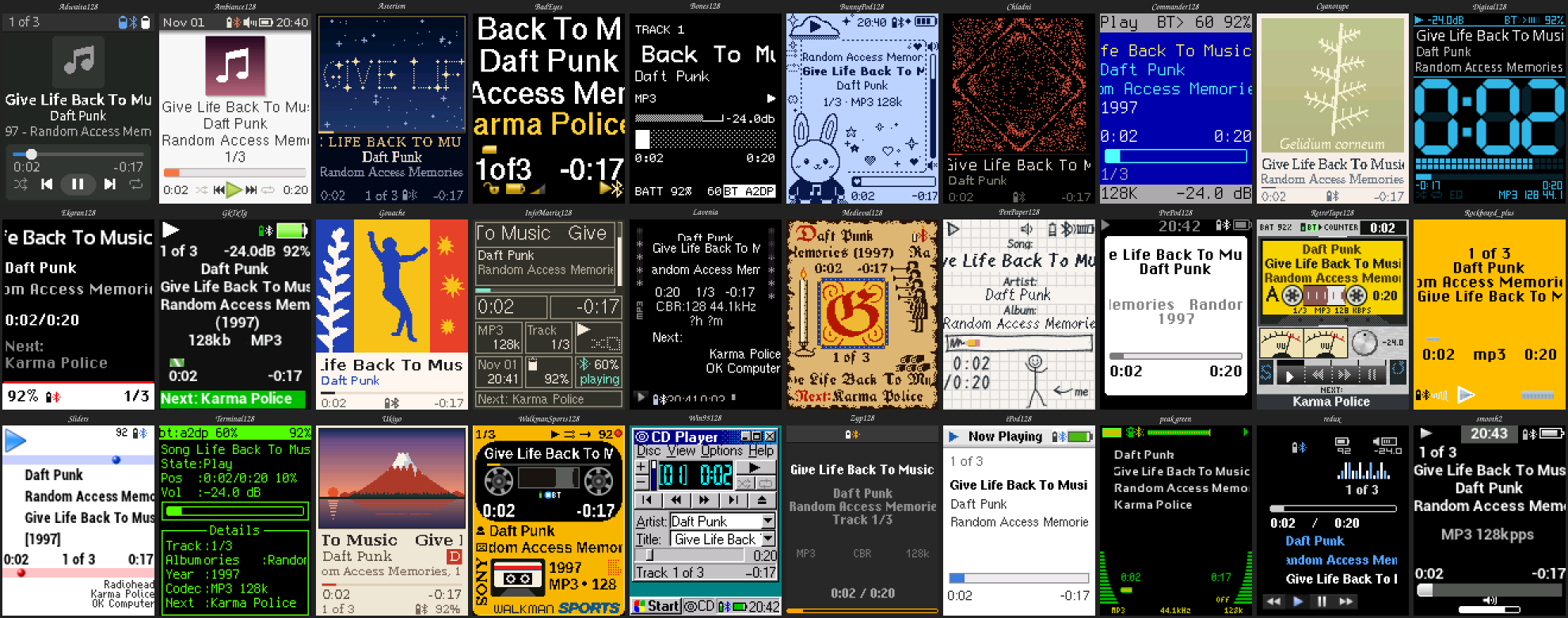
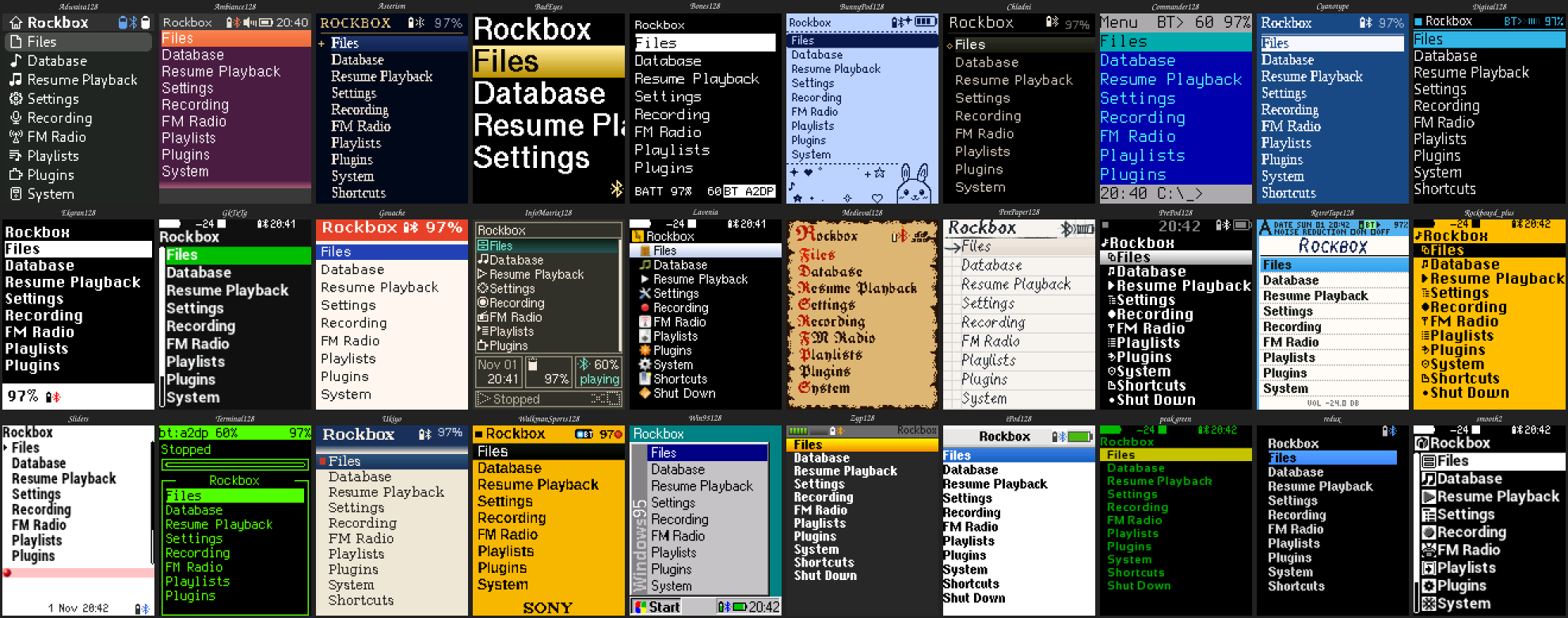
Note: This is a WIP screenshot, there have been bug fixes & some of these got
cut because of unclear licensing.
Note that heavy themes can cause some issues, so I would suggest sticking with
lightweight ones.
Fin
Well, reverse engineering a completely undocumented chipset was one of the
hardest things I could think of to do, and Claude can ace it. I’m planning on
porting Rockbox to a bunch of other cheap MP3 players.
Appendix: Identifying a YP3
There are lots of clones that look like each other. The YP3 specifically:
- Only has 5 buttons - dpad and center
- no power, volume
- symbols molded into buttons, not printed on them in white
- Has a reset pinhole on the right
- Speaker on top rear
- USB on bottom right, headphone jack on left
- SD card on the left
- I think they’re all black
Also, these screens are made of cheese, you’ll want a screen protector.
</details>Bluetooth HID drivers
Yes, you can pair a PS4 controller or keyboard to Rockbox. I wanted to see how much we could do with the existing Bluetooth stack
Note: This is a WIP screenshot, there have been bug fixes & some of these got cut because of unclear licensing.
- no power, volume
- symbols molded into buttons, not printed on them in white